
By Diplomatic Insider
German Foreign Minister Dr. Johann Wadephul denied that reported meetings between former and current German and Russian officials in Baku were part of Germany’s official diplomacy, saying the German government had no knowledge of the contacts and describing them as private.
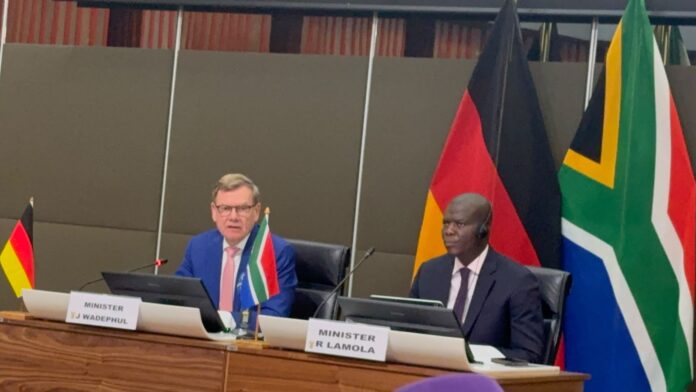
Wadephul made the remarks on Thursday during a joint press conference with South African Minister of International Relations and Cooperation Ronald Lamola in Pretoria, answering a question from journalist Turkmen Terzi.
Terzi referred to comments made by Azerbaijani President Ilham Aliyev during a joint press conference with German Chancellor Friedrich Merz in Berlin on Tuesday, in which Aliyev said that former and current German and Russian officials had held meetings in Baku this month and last year. Aliyev added that “Azerbaijani authorities received no information about these meetings from either Germany or Russia.”
Aliyev said, “Azerbaijani authorities received no information about these meetings from either Germany or Russia.”
Asked whether the reported contacts indicated that diplomacy with Russia was continuing behind the scenes, Wadephul rejected any suggestion that the meetings represented official German diplomacy.”They are certainly not part of German diplomacy. In any case, I had no knowledge of these talks. They were not conducted on behalf of or with the knowledge of the Federal Foreign Office. Therefore, I believe they were probably of a private nature.”
Wadephul reiterated that Germany’s policy toward Russia and the war in Ukraine remained unchanged.
“Our position on resolving this conflict is completely clear,” he said. “Germany stands unwaveringly by Ukraine. We are Ukraine’s largest supporter, and that will remain the case.”
He noted that the European Union’s 21st sanctions package was intended to further increase pressure on Moscow.
“The sanctions make it clear that this war is becoming increasingly costly for Russia in every respect,” he said.
The German foreign minister again called on Russia to begin negotiations, stressing that Ukraine had already expressed its willingness to negotiate without preconditions.
“It is now time to come to the negotiating table,” Wadephul said. “This appeal is clearly directed at the Russian side because Ukraine is prepared to negotiate without preconditions.”
He added that a ceasefire would provide the best basis for meaningful negotiations.
“The sooner talks begin and the sooner this war can end, the better,” he said, adding that several international partners were working to encourage Russia to engage in peace talks.
Wadephul also stressed that Germany would continue coordinating all diplomatic efforts closely with its European allies.
During the same press conference, Terzi also asked Wadephul about criticism from U.S. President Donald Trump during the recent NATO summit in Ankara. Trump had accused several NATO members, including Germany, of spending too little on defense and failing to provide sufficient support to the United States over Iran.
In response, Wadephul defended Germany’s record, describing the NATO summit in Ankara as a success.
“The NATO summit in Ankara was a great success because we stand together,” he said.
He said allies had reaffirmed their commitment to achieving NATO’s defense spending targets and emphasized Germany’s significant increase in military expenditure.
“The Federal Republic of Germany is among the countries that have increased defense spending the most,” Wadephul said. “Our defense spending has more than tripled since 2014, and we will reach the 3.5 percent target for core military spending before the end of this decade.”
“We see ourselves in both a leading and exemplary role, and we are fulfilling that responsibility,” he added.
Wadephul was in South Africa on a working visit on 22–23 July, hosted by South African International Relations and Cooperation Minister Ronald Lamola. The ministers reviewed progress on the South Africa–Germany Action Plan, discussed cooperation on strengthening democratic resilience and the Investing for Peace Initiative, and exchanged views on regional and global developments, including the war in Ukraine, conflicts in the Middle East, and peace and security on the African continent.
Germany is South Africa’s largest European trading partner, with bilateral trade valued at approximately R295 billion in 2025. More than 600 German companies operate in South Africa, employing around 100,000 people, while Germany is also one of the country’s largest foreign investors and its third-largest source of overseas tourists.
Photo: Turkmen Terzi.
Photo caption: German Foreign Minister Dr. Johann Wadephul answers a question from journalist Turkmen Terzi during a joint press conference with South African Minister of International Relations and Cooperation Ronald Lamola in Pretoria, South Africa, on 23 July 2026.